Vevay
Little WomenVevay is the Swiss lakeside setting in which Amy March’s separation from her family becomes the immediate backdrop for a decisive change in her relationship with Theodore Laurence. Far from home and mourning Elizabeth March, Amy’s private sorrow makes visible a mature, tender side of her character that Theodore Laurence had not previously recognized; the place therefore functions not merely as scenic background but as the setting where grief, homesickness, and love converge.
Setting and Arrival
Vevay lies in Switzerland, part of the slow European journey undertaken by Amy March and her companions after the heat drove them from Nice in May. Their route had taken them through Genoa and the Italian lakes, and the family decided that Amy should not cut short her visit when the news of Elizabeth March’s decline failed to reach her in time. Since she could no longer say goodbye, remaining abroad was presented as a way for absence to soften the coming sorrow, although the arrangement left her heart heavy and her thoughts persistently turned toward home.
The setting is defined by the proximity of the lake and by the calm beauty of La Tour, where the Carrol family was living en pension. When Theodore Laurence received the news, he travelled from Germany, hurried to the quay as soon as his boat arrived, and went along the shore to find her. The geography gives his arrival a purposeful shape: Vevay is not an incidental stop but the destination toward which his promise, concern, and delayed understanding draw him.
The Garden at La Tour
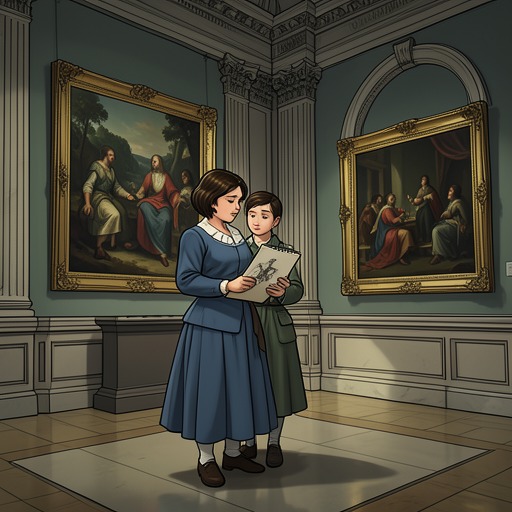
The key scene unfolds in a pleasant old garden beside the lake, with chestnut trees overhead, ivy climbing through the grounds, and the black shadow of a tower stretching across the sunlit water. A broad, low wall contained a seat where Amy often read or worked, using the surrounding beauty to console herself. On the day Theodore Laurence found her, she sat there with her head resting on her hand, thinking about Elizabeth March and wondering why he had not come.
Amy did not hear him cross the courtyard or see him pause in the archway leading from the subterranean path into the garden. From that concealed position, he observed her before she knew she was being watched. The details around her altered his understanding of her: the blotted letters in her lap, the black ribbon tying back her hair, the patience and pain visible in her face, and the small ebony cross at her throat, a gift from him that she wore as her only ornament. Vevay thus creates a threshold between observation and recognition. Theodore Laurence does not fall in love with an abstract ideal of Amy; he sees, in the stillness of the garden, a previously overlooked tenderness.
Emotional Turning Point
The value at stake in Vevay is first consolation and then reciprocal love. Amy has been waiting across the lake for Theodore Laurence to come and comfort her, while he arrives carrying both joy and sorrow, hope and suspense. Their meeting changes the emotional charge of the scene immediately. When Amy looks up, she abandons everything and runs to him, greeting him with unmistakable love and longing. Her response confirms that the attachment he had hesitated to name is already mutual.
The setting also marks the movement from absence to presence. Amy’s homesickness had fixed her attention on the distant March family, while Theodore Laurence’s arrival gives her a companion who understands the emotional weight of the news she has received. The garden’s quietness allows recognition to occur without public ceremony: the transformation begins through sight, movement, and reunion before it is formalized in speech.
The Lake and the Marriage Plot
The relationship’s formal turning point occurs on the lake at noon rather than in the moonlit chateau garden Theodore Laurence had imagined. He and Amy spend the morning floating between St. Gingolph and Montreux, with the Alps of Savoy, Mont St. Bernard, the Dent du Midi, Vevay in the valley, and Lausanne on the hill beyond them. The cloudless sky, blue water, and boats scattered across the lake provide a broad, open setting for a conversation that proves far less ceremonious than his fantasy.
As they pass Chillon, they talk about Bonnivard; when they look toward Clarens, they think of Rousseau and the love story associated with him. The literary associations mirror their own developing romance, but the scene refuses elaborate theatricality. Their union is settled in a few blunt words while they are on the lake in daylight. Vevay therefore anchors the shift from romantic expectation to emotional certainty: the imagined moonlit declaration gives way to an ordinary, direct resolution because Amy already knows Theodore Laurence’s feeling and had given him her answer long before he spoke.
Narrative Significance
Vevay gathers several of the novel’s recurring contrasts into one place. Amy is abroad, yet her mind is at home; she is surrounded by beauty, yet grief gives the landscape its emotional meaning; and Theodore Laurence arrives after a long period in which his love for Josephine March had obscured his ability to perceive Amy. The scenery does not erase sorrow. Instead, the lake, garden, tower, and distant mountains hold sorrow long enough for a different future to become visible.
The location’s significance extends beyond the immediate romance. Elizabeth March’s failing health supplies the grief that brings Amy and Theodore Laurence together, while Amy’s earlier effort to become less selfish and more like Elizabeth March has prepared the mature conduct he now sees. Vevay is consequently a place of emotional conversion: separation exposes character, grief awakens recognition, and recognition leads to the marriage of Amy March and Theodore Laurence. The later household formed around that marriage confirms that the lakeside encounter was not a temporary consolation but the beginning of a lasting family bond.